Going green: HDB closer to 2020 solar power target as it awards tender to Sembcorp
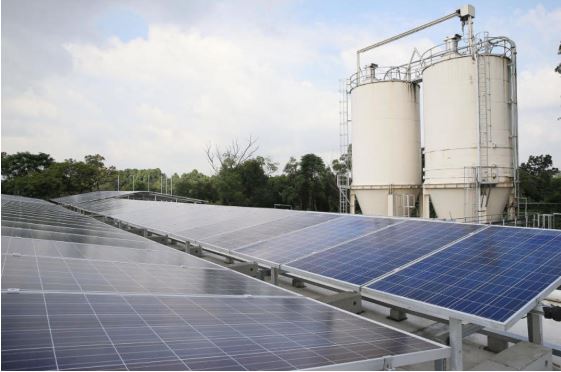
this is index.phpSINGAPORE – More Housing and Development Board (HDB) flats will be solar powered as the agency ramps up efforts to reduce Singapore’s carbon emissions and move closer to its target of having solar panels installed in 5,500 blocks by 2020.
The HDB has awarded its third solar leasing contract to Sembcorp Solar Singapore – subsidiary of industrial conglomerate Sembcorp Industries – and its appointed engineering, procurement and construction player, Kurihara Kogyo Co.
The project will see the company installing solar photovoltaic panels on the rooftops of 848 HDB blocks in West Coast and Choa Chu Kang, and 27 government sites by the second quarter of 2020, said the HDB in a press release on Sunday (June 24).
The government sites include two sites under the Institute of Technical Education, the Building and Construction Authority Academy, the Heritage Conservation Centre under the National Heritage Board, and a field under Sport Singapore.
This latest tender falls under the SolarNova programme, which aims to spur the growth of Singapore’s solar industry by encouraging government agencies to use solar power.
When completed, the total number of HDB blocks with solar panels will exceed 2,400, which will bring it closer to achieving its goal of having panels in 5,500 blocks by 2020.
The solar power generated from these rooftops can be used to power common services such as lifts, pumps and lighting in common areas in the daytime.
Singapore plans to achieve 350 MWp of solar capacity by 2020, and more than 60 per cent of that will come from HDB’s solar initiatives and programmes.
By that time, the solar panels at HDB blocks are expected to have a capacity of 220MWp, which can generate the equivalent energy to power some 55,000 four-room flats and reduce carbon emissions by 132,500 tonnes a year.
GOING GREEN
While this is a step in Singapore’s efforts to go green, Professor Subodh Mhaisalkar, executive director of the Energy Research Institute at Singapore’s Nanyang Technological University, said more can be done, particularly if developers and large industrial estates join in the initiatives.
He noted that the Government’s efforts at raising the adoption of solar energy has been picking up, and said it will be on track to meet the 2020 target capacity of 350 MWp.
For instance, national water agency Public Utilities Board had put up a tender in April to conduct engineering studies for the deployment of floating solar panels in Bedok Reservoir and Lower Seletar Reservoir.
However, Prof Subodh said there is still a big gap between the 2020 SolarNova target and Singapore’s potential to generate two gigawatt-peak (GWp) of solar power – or 25 per cent of Singapore’s energy demands – by 2025.
“The next opportunity is for other large industrial estates or developers (with large rooftops) to join in… if we really are ambitious in putting up 2 GWp (of solar capacity),” he said.
Going forward, Prof Subodh expects more from the private sector to install solar panels on their rooftops as the cost of these systems continue to go down, along with the costs of batteries or energy storage solutions.
Mr Koh Chiap Khiong, Head of Singapore, South-east Asia & China (Energy), Sembcorp, acknowledged that Singapore’s solar energy market still has “a fair bit of room to grow”.
He said: “We have seen good momentum in recent years, with quite a few companies and industrial facilities exploring rooftop solar solutions. As a company, we’ve moved into this space aggressively.”
Mr Koh added that the Government’s push towards solar energy and its programmes to work with companies to install solar panels in HDB blocks and government facilities will “go a long way to accelerating even wider application of the technology here.”
‘MAJOR SOLAR PLAYER’
The HDB’s contract with Sembcorp Solar Singapore and Kurihara Kogyo Co. is the third solar leasing tender under the SolarNova programme.
Sembcorp Solar and Kurihara Kogyo were picked from nine local and foreign companies.
A Sembcorp spokesperson said that the deal will make the firm a “major solar player in Singapore”.
“Sembcorp’s combined solar energy portfolio in Singapore now extends to 104 megawatts of capacity situated across more than 1,500 sites in the country. This is enough to power around 27,400 four-room HDB flats in Singapore per year,” said its spokesperson.
This project will be internally funded and is not expected to have a material impact on the earnings per share and net asset per share of Sembcorp for the financial year ending December 31 this year, said Sembcorp.
With the third tender, HDB will be able to harness 190 MWp of solar capacity from 2,400 HDB blocks – which already makes up more than 85 per cent of HDB’s commitment under the SolarNova programme.
The first was awarded to Sunseap Leasing in December 2015 to install solar panels with a capacity of 76 MWp on the rooftops of some 800 HDB blocks.
The second tender was awarded to Million Lighting Co in June last year, where solar panels with a capacity of 40MWp will be installed at 636 HDB blocks and 31 government sites.
On average, HDB blocks that are installed with solar panels are able to achieve net-zero energy consumption, where the excess solar energy is channelled back into the grid. About 4.1 GWh of solar energy harnessed from HDB blocks is currently exported to the grid each month.
HDB chief executive officer Cheong Koon Hean said the board is making steady progress in its solar initiatives.
To date, solar panels have been installed or fitted in close to a quarter of 10,000 HDB residential blocks. In two years, more than half of these blocks will be fitted or identified for solar installation, added Dr Cheong.
HDB is expected to call for a fourth tender in the fourth quarter of 2019.

Construction company fined for housing foreign workers in cramped, filthy conditions
this is index.phpSINGAPORE: A construction company was fined S$352,500 last Thursday (May 24) for housing its foreign workers in overcrowded, filthy and unsafe conditions, the Ministry of Manpower (MOM) said on Tuesday.
Keong Hong Construction had also been barred from employing foreign workers, according to a press release by the Manpower Ministry.
The company was the operator of a construction site temporary quarters at Sembawang Crescent, which had an approved occupancy of 182 foreign workers.
MOM officers, however, found 207 foreign workers living there during an inspection on Mar 8 last year.
Aside from its own workers, Keong Hong was also found guilty of abetting 17 other employers to house their foreign workers in the same quarters, the Manpower Ministry said.
The living space was cramped, with areas for sleeping simultaneously used for drying of laundry and improper storage of food, MOM said.
The foreign workers stayed in 31 makeshift rooms which were “untidy and filthy” with poor ventilation and inadequate lighting which were exacerbated by the overcrowded conditions, according to the ministry.
The rooms were also constructed from zinc sheets and plywood, which did not meet fire safety regulations, it said, adding that bulk and discarded items in the sleeping areas posed a fire hazard to workers.
In addition, the quarters had inadequate and poorly maintained toilet facilities, and there was just one communal bath for more than 200 workers to share in a makeshift bathroom.
“The living conditions compromised the safety and well-being of the workers,” MOM said in the press release.
The ministry said that after the inspection, the dormitory operator was ordered to rectify the poor living conditions and comply with the occupancy limit, with the excess foreign workers relocated to other approved accommodations.
In total, Keong Hong pleaded guilty to 47 of 207 charges under the Employment of Foreign Manpower Act, with the remaining 160 charges taken into consideration for sentencing.
Ms Jeanette Har, MOM’s Director of Well-Being Department, said that while the ministry has seen an improvement in the foreign worker housing landscape, some employers and operators continue to have little regard for workers’ safety and well-being.
“MOM will take stern action against those who fall short of their legal responsibilities towards their foreign workers,” she stated.
Foreign workers who have issues with their housing conditions should first bring the matter to the attention of their employers, MOM said.
If their employers fail to make improvements to the living conditions, they can seek advice from the Migrant Workers’ Centre by calling +65 6536 2692 or report the matter to MOM at +65 6438 5122.
Members of the public can also report cases confidentially to MOM by calling +65 6438 5122 or emailing mom_fmmd@mom.gov.sg.
Validity and Renewal of bizSAFE Status for Enterprises
this is index.php| bizSAFE Level | Validity | Renewal procedure |
| bizSAFE 1 | bizSAFE status is valid for 6 months from the date of approval. Note: In the event there is a change of CEO/ Top Management in the company, the new CEO/ Top Management shall attend the relevant bizSAFE Level 1 Workshop if he/ she has not attended one before. This condition will apply regardless of the bizSAFE Level (1 to Star) an enterprise is currently at. | Applicants are required to progress up to Level 2 and above in order to continue their bizSAFE Recognition. |
| bizSAFE 2 | bizSAFE status is valid for 6 months from the date of approval. In the event there’s a change to the RM Champion, a new RM Champion shall attend the bizSAFE RM Course. This condition will apply regardless which bizSAFE Level (1 to Star) an enterprise is currently at. | Applicants are required to progress up to Level 3 and above in order to continue their bizSAFE recognition. |
| bizSAFE 3 | bizSAFE status is valid for 3 years from the date of approval or upon expiry of the relevant external certifications, whichever is earlier. Note: For any relocation of operation or change in the nature of operation of the organisation, WSH Council reserves the right to request the company to re-audit its Risk Management implementation by an MOM-approved WSH auditor. | Engage an MOM approved WSH Auditor to audit the company’s RM implementation. Submit bizSAFE renewal application online and attach the following; Supporting document to verify CEO/Top/Senior Management who attended the bizSAFE L1 Workshop for CEO/Top Management. Certificate of Attendance for bizSAFE Level 1 Workshop for CEO/Top Management Certificate of Attendance for bizSAFE RM Course RM Implementation Audit Report |
| bizSAFE 4 | bizSAFE status is valid for 3 years from the date of approval or upon expiry of the relevant external certifications, whichever is earlier. In the event there’s a change to the WSHMS Champion, a new WSHMS Champion shall be appointed to attend the bizSAFE Level 4 course. This condition will apply regardless which bizSAFE Level (1 to Star) an enterprise is currently at. | Submit bizSAFE renewal application online and attach the following; Supporting document to verify CEO/Top/Senior Management who attended the bizSAFE L1 Workshop for CEO/Top Management. Certificate of Attendance for bizSAFE Workshop for CEO/Top Management RM Implementation Audit Report Certificate of Attendance for bizSAFE WSHMS course bizSAFE |
| bizSAFE STAR | bizSAFE status is valid for 3 years from the date of approval or upon expiry of the relevant external certifications, whichever is earlier. Note: i) For any relocation of operation or change in the nature of Operation of the organization, WSH Council reserves the right to request the company to re-audit its WSHMS by an SAC Accredited Auditor. ii) The Level Star expiry date will be tagged to your SS ISO 45001/ISO 45001 certificate expiry date. iii) RM Audit Report has 3 years validity from the date of Audit Report. | Submit bizSAFE renewal application online and attach the following; Supporting document to verify CEO/Top/Senior Management who attended the bizSAFE L1 Workshop for CEO/Top Management. Certificate of Attendance for bizSAFE Level 1 Workshop for CEO/Top Management Certificate of Attendance for bizSAFE WSHMS course SS ISO 45001 Certificate issued by SAC accredited certification bodies OR ISO 45001 certificate or other equivalent certificate and a RM Implementation Audit Report by MOM Approved auditor. |
4 projects win BCA’s Platinum award for user-friendly design
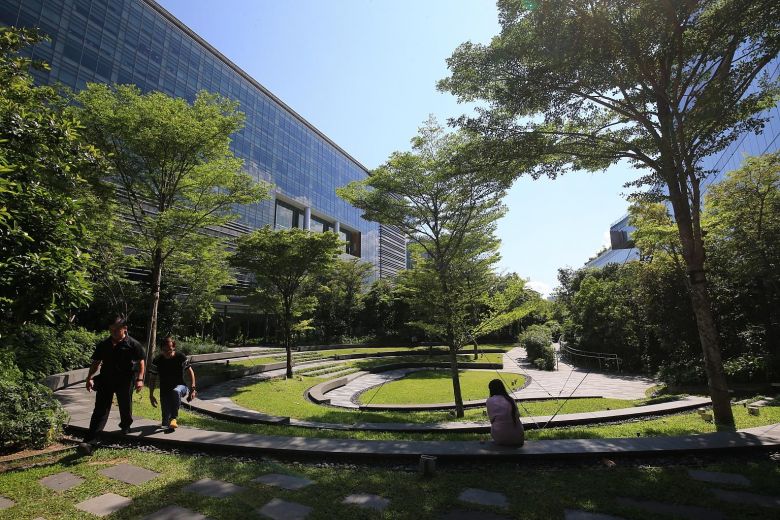
this is index.phpIt is a business park so seamlessly connected to nearby parks that otters have entered its lush, green compound for illicit suppers at a fish pond.
Animals find themselves right at home at the Mapletree Business City II in Pasir Panjang, which boasts more than 1,400 trees.
These garden features have helped the business park win big at the Building and Construction Authority’s (BCA) Universal Design Mark Awards – it is one of four projects this year to clinch the top Platinum award.
The other three are City Square Mall, Kampung Admiralty and Changi Airport Terminal 4. Only one project won Platinum last year.
The awards, introduced in 2012, recognise buildings that are accessible and user-friendly. There are 26 winners this year, including developments such as condominiums, hospitals and shopping malls, said BCA yesterday.
The awards will be presented on May 22.
Extensive open areas with high ceilings and good air circulation are by no means an accident, said Mr Moses Lee, Mapletree’s director of investments and asset management for Singapore investments, during a tour of the business park on Wednesday. “The ground floor and mezzanine floor are for parking and traffic. This allows more open areas on the elevated deck for pedestrians to enjoy public spaces and the lush landscape,” he said.
The planning even extends to knowing which way the wind blows.
Fitted at the side of the business park’s sheltered walkways are automated rain screens that are lowered in bad weather. Such attention to detail has attracted tenants such as Google to the business park.
Another winner this year is City Square Mall by City Developments (CDL), the first Platinum recipient under the new BCA-MSF Universal Design Mark for Family-Friendly Business.
The category is a collaboration between BCA and the Ministry of Social and Family Development and recognises projects that are family-friendly not just for their design but also their services.
Besides having a playground with a merry-go-round that caters to children who use wheelchairs, City Square Mall also ensures that all staff at its service counter are trained in first aid.
This proved helpful last December, said CDL’s centre director of the mall, Mr Lionel Chua, when a child fell and had a cut on his temple. “We want our staff to engage shoppers and always be there for them.”
City Square Mall was also one of the first malls to introduce “help call points” at its entrances when it opened in 2009. Shoppers can use these call machines to contact service staff if they need help – for example, if they require wheelchairs.
There is also an air-conditioned taxi stand in the basement.
Mr Clement Tseng, BCA group director for building plan and management, said: “The winners for this year’s BCA Universal Design Mark Awards exemplify an emphasis on people-centric designs to create communities and promote inclusivity for all, including people with disabilities and the elderly.”
Source: https://www.straitstimes.com/singapore/4-projects-win-bcas-platinum-award-for-user-friendly-design
Partial works resume at collapsed Upper Changi East viaduct
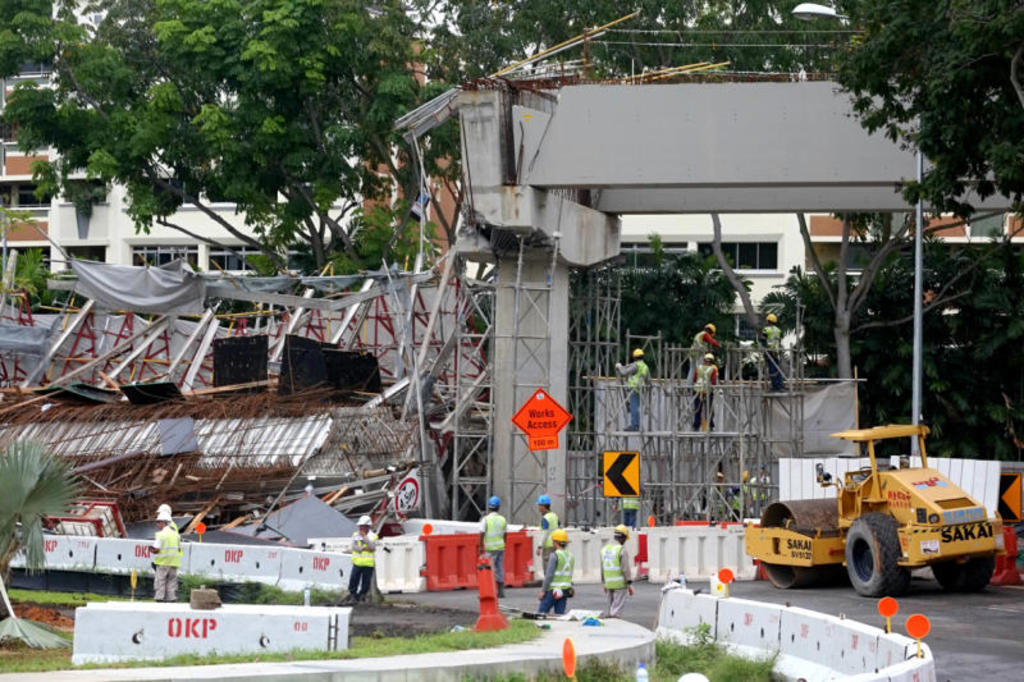
this is index.phpSINGAPORE — Eight months after the collapse of an under-construction Pan-Island Expressway (PIE) viaduct at Upper East Coast Road killed one worker and injured 10 others, partial works on the project have resumed despite investigations into the tragic incident are still ongoing.
Woman charged over housing 21 workers in one apartment
this is index.phpA 53-year-old woman was yesterday charged in the State Courts by the Ministry of Manpower (MOM) for abetting an employer to house foreign workers in overcrowded private residential premises.
Zhou Fengxing faces 21 charges under the Employment of Foreign Manpower Act. If convicted, she could be jailed for up to 12 months and/or fined up to $10,000.
Zhou’s company, Sino Star Enterprise, which arranges accommodation for foreign workers, faces the same number of charges under the Act, MOM and the Urban Redevelopment Authority (URA) said in a joint statement yesterday.
URA also charged Zhou and Sino Star with three counts each of unauthorised change of use of private residential units under the Planning Act, and two counts of abetting the unauthorised change of use of private residential units.
If found guilty, Zhou and Sino Star could be fined up to $200,000 on each charge.
The case was uncovered as part of MOM’s enforcement efforts against foreign worker housing offences.
Investigations revealed that Sino Star was the master tenant of several units at a residential apartment block in Geylang. From March to July 2015, Zhou gave consent for Sino Star to sublet one unit to an employer to house 21 foreign workers. The unit had exceeded URA’s then prevailing occupancy cap of eight people. This was revised to six people in February last year.
Apart from illegal partitions found inside, there was also overcrowding in the unit. This resulted in extremely unsanitary conditions, which compromised the well-being of the workers.
MOM ordered the employer to relocate the workers promptly. They were moved out to a purpose-built dormitory within two weeks from the date the directive was issued.
The cases against Zhou and Sino Star have been adjourned to April 24 for a further mention.
Under the Employment of Foreign Manpower (Work Passes) Regulations, employers are required to provide accommodation for their foreign workers which comply with the various statutory requirements. Employers who contravene any of the conditions of the work pass will be guilty of an offence.
On top of penalties imposed by the court, MOM will also bar errant employers from employing foreign workers. It will also take firm action against errant property owners or tenants who fraudulently enter into subletting arrangements with employers that result in overcrowding conditions for the foreign workers.
Under URA’s regulations, private residential properties are subject to an occupancy cap of six unrelated people. All occupants must fulfil a minimum stay duration of three consecutive months.
MOM urges foreign workers who have issues with their accommodation to first raise the matter with their employer. If their employers fail to make improvements to the living conditions, they should immediately seek advice and assistance from the Migrant Workers’ Centre on 6536-2692 or report the matter to MOM on 6438-5122.
Members of the public can refer foreign workers in distress to MOM at the same number, or e-mail mom_fmmd@mom.gov.sg. The information will be kept strictly confidential.
Firm fined $12,000 for water pollution says it is taking steps to improve practices
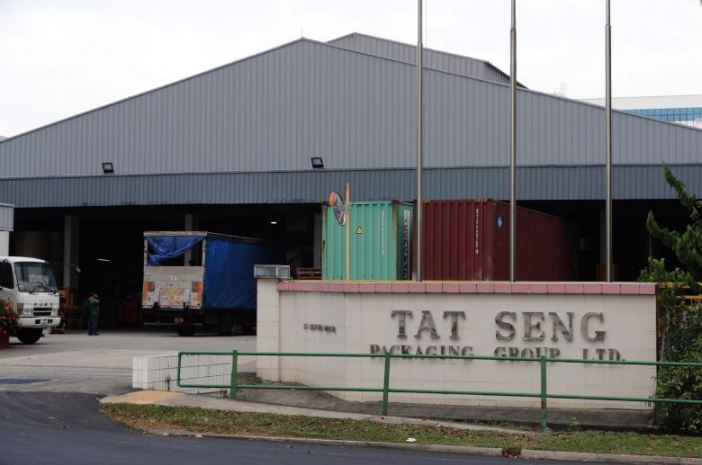
this is index.phpSINGAPORE – Tat Seng Packaging Group, which was fined $12,000 for discharging copper-tainted water above the allowable limit, said it views the matter seriously and has looked into ways of minimising the impact of waste water discharged into the environment.
We have moved!
this is index.phpThank you! We appreciate your continued support and look forward to serving you better 🙂

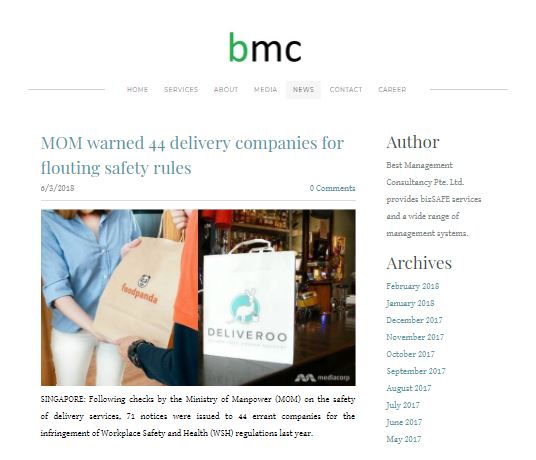
MOM warned 44 delivery companies for flouting safety rules
this is index.phpSINGAPORE: Following checks by the Ministry of Manpower (MOM) on the safety of delivery services, 71 notices were issued to 44 errant companies for the infringement of Workplace Safety and Health (WSH) regulations last year.
Worker dies in accident at construction site in Jalan Sultan
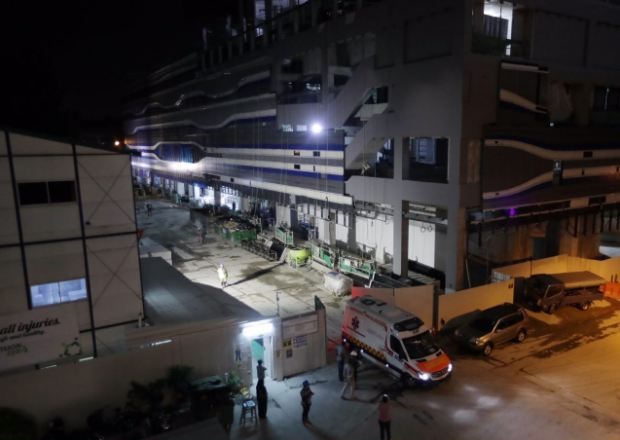
this is index.phpSINGAPORE – A 41-year-old construction worker died after his neck was pierced by a reinforcing bar in an accident at a work site in Jalan Sultan on Monday night (Feb 5).