
Don’t neglect workplace safety amid Covid-19 measures, firms urged
this is index.phpWith all the focus on Covid-19 safe management measures as companies resume operations, firms must not forget the fundamentals of workplace safety, said Senior Minister of State for Manpower Zaqy Mohamad yesterday.
Ten workplace deaths have been recorded since June 2, he said, with the latest four taking place last month and this. The four cases occurred in high-risk operations.
The number of deaths is not higher than usual, but Mr Zaqy said there is concern that workers may be less familiar with safety measures after a period of inactivity.
Companies may feel an urgency to make up for lost time, but he urged employers to relook safety policies, give workers time to adjust, and conduct refresher training if needed.
“I think it’s important to put back measures that we used to have, and ensure that as we restart, while there’s sometimes certain pressures to get back on track and to catch up on lost time, this is not at the expense of workers’ safety and health,” he said.
“So this is one area where MOM (Ministry of Manpower) will be stepping up to put in place more enforcement measures, more surveillance on the ground.”
There were 16 workplace deaths in the first six months of this year.
Last year, there were 17 in the first half and 22 in the second half.
The latest four deaths took place in different sectors, including manufacturing and construction, and the causes were also different, said Mr Zaqy.
A 27-year-old Indian national died last week after he was electrocuted while dismantling an electrical distribution board at 170 Still Road.
Mr Zaqy said that besides visiting workplaces, MOM will also be sending out advisories and alerts to all employers.
“When workers have been out for some time, managers and site supervisors need to really sit down, rework the process, and take stock of the more risky work to be done and how that applies under the new safe measures,” he said.
Mr Zaqy was speaking after a visit to a construction worksite at the Chinese Garden, which is being spruced up along with the Japanese Garden.
The project, managed by Kuan Aik Hong Construction, started last November, but work was mostly halted during the two-month circuit breaker – from April to June – to stem the spread of Covid-19.
To ensure the safety of its workers, Kuan Aik Hong has implemented measures such as having each worker wear a safe distancing device that beeps when two devices come within a preset distance of each other, such as 1m.
The firm’s 220 workers on site are also segregated into three zones. Workers from different zones are not allowed to interact and have to stay in different dormitories.
In terms of construction work safety, a hydraulic static ring pile breaker is used instead of a pneumatic drill – the former is safer for workers and also reduces their exposure to noise and dust pollution.
Mr Fabian Loi, general manager of Kuan Aik Hong Construction, said that while there is always pressure to catch up with work schedules, safety comes first.
The firm’s number of on-site supervisors has been increased, he added. “They not only do supervision to improve safety, but also provide a listening ear to workers… We think mental health well-being is as important as physical safety.”
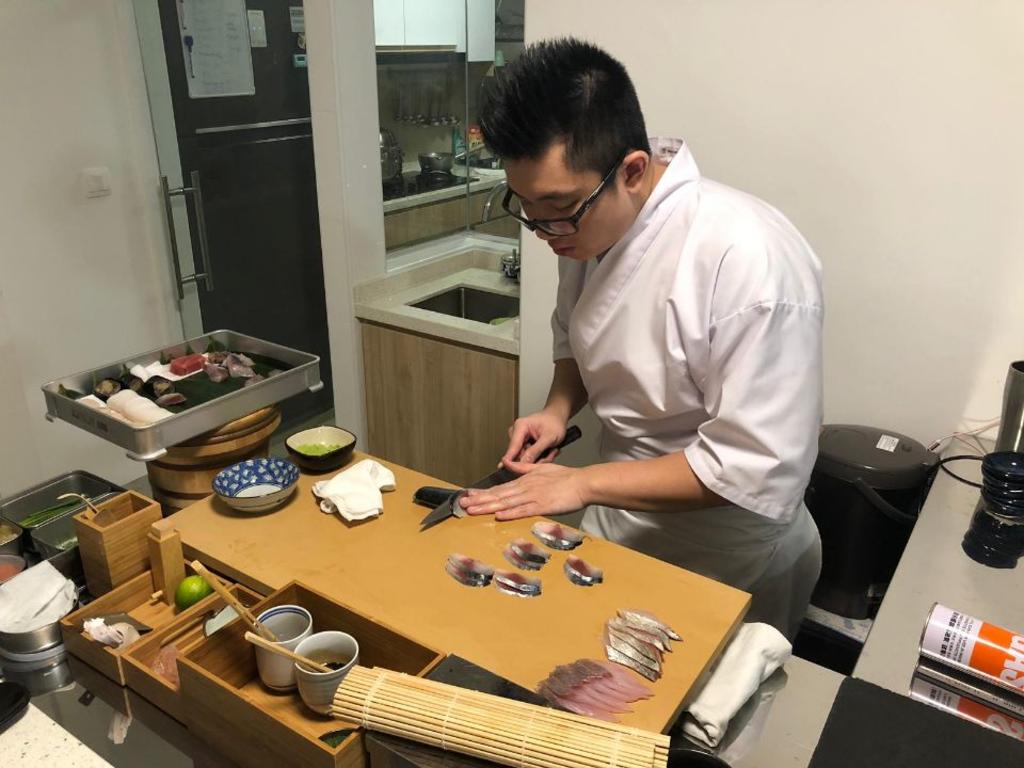
SFA bans raw fish sale from homes for safety reasons, hitting income of some home-based business owners
this is index.phpSFA said ready-to-eat raw fish may not be sold by home-based businesses
The agency said this food is high risk because it is not cooked
Some home-based chefs selling sushi and sashimi were surprised by ban
SINGAPORE — Since last month, home-based food businesses have been banned from selling ready-to-eat raw fish by the Singapore Food Agency (SFA) in a move that has caught several home chefs off guard — and left at least one worried he may have to close his business.
In response to TODAY’s queries, the SFA said that ready-to-eat raw fish is considered a high-risk food as it is uncooked. Home-based businesses (HBB) are not allowed to prepare it for sale as they may not have the proper facilities and processes to do so safely, SFA added.
An SFA spokesperson explained that under the HBB scheme, operators are subject to rules on food that is unsafe or unfit for consumption in the Environmental Public Health Act (EPHA) and the Sale of Food Act (SOFA).
“As with the consumption of all raw food, there are some food safety risks in consuming ready-to-eat raw fish,” the spokesperson said.
“As a general precaution, vulnerable groups, especially young children, pregnant women, elderly persons, or people with chronic illness, should exercise caution by avoiding the consumption of raw food,” the spokesperson added.
Recent reports have cited bacterial infections associated with eating raw freshwater fish. For example, 50 cases of invasive Group B Streptococcus (GBS) were reported by public hospitals in July — twice the average monthly figure of 25 from earlier this year, The Straits Times reported.
‘THROW IN THE TOWEL’
Two home-based business owners selling ready-to-eat raw fish told TODAY they were not aware of the ban.
Mr Jeffrey Yeo, 48, a full-time home chef who has been conducting private home dining services and selling a variety of Japanese takeaway fare since June last year, was “surprised” when he was paid a visit by SFA and Housing and Development Board (HDB) officers on Sept 25.
The officers had placed an order for sashimi and upon collecting it at Mr Yeo’s home, revealed they worked with the authorities and told him that he was not supposed to sell the raw fish.
“I told them that I wasn’t aware because it isn’t stated anywhere in the guidelines, and they said the rule has been around for two years which now confuses me after I learnt it was only implemented in September,” he said.
“After that, they said they would like to come in and take a look around and take a sample from the box of sashimi that I had put out for takeaway that day,” Mr Yeo said.
In response to TODAY’s queries, SFA said HBB owners are obliged to refer to SFA’s guidelines on food safety and hygiene practices.
Mr Yeo said that he has not heard back from the SFA since and has only been told that they are investigating the matter. SFA has also approached his suppliers, he has learnt.
While Mr Yeo has continued with his private dining sessions and takeaway orders with a tweaked menu since he stopped serving raw fish, he has lost 40 per cent of his weekly business, comprising the sale of sashimi and sushi. One private dining client cancelled.
“It (preparing raw fish) requires painstaking hours of work,” he said.
“It requires expertise and knowledge about the fish, what do we do in the different seasons and I also don’t serve freshwater fish sashimi,” said Mr Yeo, who travelled to Japan last year for a crash course in sushi, sashimi and Japanese cuisine.
He left his 15-year career in the corporate world to fulfil his passion for Japanese food and to care for his young daughters at home.
When he was first told of the ban, Mr Yeo considered opening a small establishment but reality soon hit.
“Unfortunately not everyone has the financial resources to go commercial. And the food and beverage industry is a high stakes business with huge upfront investments. Not everyone is as financially able to go this route. Central kitchens aren’t cheap too,” said Mr Yeo.
For now, he has suspended his private dining sessions past October and is worried he will have to “throw in the towel” unless he can talk to SFA about a possible solution.
Another home chef who specialises in Japanese fare is Mr Jeremy Tan, 33, who has been conducting private home dining services and selling a variety of takeaway Japanese fare since January last year.
Mr Tan’s career as a chef began seven years ago with stints in Japanese kitchens, working as an instructor at the sushi school Tokyo Sushi Academy and even opening his own establishment for a year in 2018 which had to shut due to manpower and rental issues.
While Mr Tan was not paid a visit by the SFA, he immediately stopped the sale of raw fish and tweaked his own menu after Mr Yeo related his experience in a Facebook post.
He, too, was not aware that the ban was enforced in September until his conversation with TODAY. “I’m in the midst of appealing to SFA. Hopefully they can go on a case to case basis,” said Mr Tan.
“I find it a bit unbelievable that I can actually sell this stuff to my customers when I used to work (at a restaurant), but I cannot do it when I’m doing my home based business despite the preparation procedure, hygiene standards and knowledge being the same,” said Mr Tan, who also travelled to Japan to get his basic sushi certification and basic Japanese cuisine preparation certification.
Mr Tan proposed that the SFA could perhaps team up with an institution to require all home-based cooks to undergo a health and safety course.
“There are a lot of home cooks who should also abide by the food safety. So I’m sure such a course will also benefit them and diners will actually feel safer to buy from all these home establishments as well,” he said.
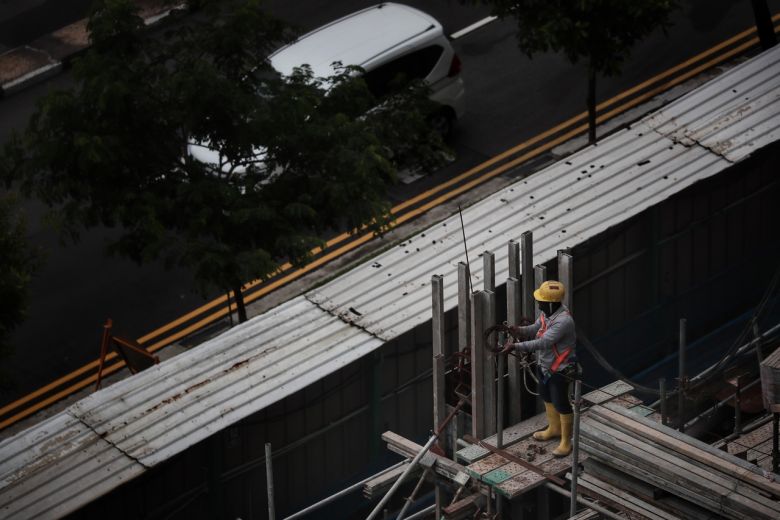
Workplace injuries in first half of 2020 fall by 25% as Covid-19 caused dip in economic activity
this is index.phpSINGAPORE – Fewer people injured themselves at the workplace in the first half of this year, likely due to the suspension of selected workplace activities from April to June caused by the coronavirus.
The number of workplace injuries has fallen by nearly a quarter from 6,630 between January and June last year to 4,996 in the same period this year.
These statistics were provided by the Ministry of Manpower (MOM) and the Workplace Safety and Health (WSH) Council on Monday (Sept 28).
However, the authorities noted that there were 16 workplace fatalities this year – close to that in the first half of last year, when there were 17 deaths. In comparison, there were 22 workplace fatalities in the second half of last year.
The leading cause of fatal injuries continued to be fall from height and vehicular-related incidents, with these two concerns relevant last year as well.
Of the total number of fatalities in the first half of this year, four deaths were from falls from height – same as the same period last year.
Vehicular-related deaths fell, from four cases in the first half of last year to three cases in the same period this year.
Meanwhile, major and minor injuries were mostly caused by slips, trips and falls, though the number of such cases fell on the whole from 1,862 in the first half of last year to 1,508 in the same period this year.
The second-most common cause of major and minor injuries was related to machinery, with 809 cases this year compared to 1,119 cases in the same period last year.
MOM and the WSH Council said the transportation and storage industry accounted for the highest number of deaths – five cases – at the workplace in the first half of this year.
The 12-month fatality rate for the industry also increased, from 3.1 per 100,000 workers as of end-December last year to 3.8 as of end-June this year.
Meanwhile, workplace deaths in the construction industry fell from six cases in the first half of last year to three cases in the same period this year. There were also fewer major injuries in the industry with 26 cases this year, compared with 61 cases in the same period last year.
The manufacturing industry also had three workplace deaths in the first half of this year and was the top contributor for major and minor injuries with 40 and 971 cases respectively.
In addition, the number of dangerous occurrences – or incidents with a high potential for multiple fatalities – fell from nine cases in the first half of last year to four cases in the same period this year. Half were fire and explosion cases, while the other two cases were crane-related incidents.
The number of occupational diseases also fell by about a quarter from 264 cases in the first half of last year to 195 cases in the same period this year. The top two diseases were work-related musculoskeletal disorder and noise-induced deafness, accounting for about nine in 10 cases.
The WSH Council said it has been engaging industries on restarting work safely following the lifting of the circuit breaker, such as through virtual forums, webinars and campaigns as well as precautionary WSH measures.
From the fourth quarter of this year, the WSH performance of companies will be published, starting with construction companies. Unsafe contractors will also be disqualified from public construction tenders.
Employers have also been required to report all work accidents that result in medical leave or light duty from Sept 1.
Mr Silas Sng, Commissioner for WSH and Divisional Director of MOM’s Occupational Safety and Health Division, said it would be counter-productive if companies rush to make up for lost time as they restart, as much effort and resources have been invested to keep the workplace safe from Covid-19.
Responding to the statistics on Monday, assistant secretary-general of the National Trades Union Congress, Mr Melvin Yong, urged companies to consider implementing a structured re-orientation programme for workers who have returned to work especially at high-risk worksites, and to conduct refresher WSH courses for all returning workers.
“As more workers return to their workplaces, there is a need to ease them back gradually into their jobs, as many have not returned to their worksites for months,” he wrote in a Facebook post.
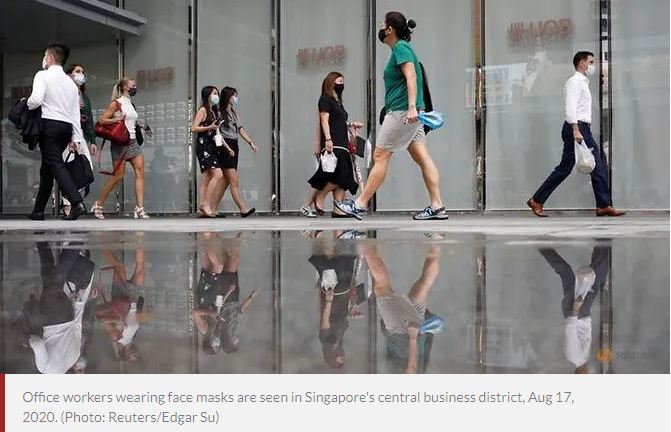
COVID-19: More people allowed to return to workplace, subject to conditions like capacity limits
this is index.phpSINGAPORE: As community cases of COVID-19 remain low in Singapore, authorities will allow more people to go back to the workplace from Sep 28, subject to conditions.
Among employees who are able to work from home, no more than half should return to the workplace at any point in time, said the Ministry of Health (MOH) on Wednesday (Sep 23).
In addition, employees should continue to work from home for at least half their working time.
“Working from home remains the default mode of working,” said MOH.
With more people expected to return to the workplace, authorities are encouraging employers to stagger reporting times, as well as implement flexible work arrangements to avoid travel during peak hours.
“In particular, we would like employers to put in place arrangements for the employees to be able to work partly at home and partly at the workplace. So it doesn’t have to be (an) ‘either-or’ (arrangement) but it can be a combination of both,” said co-chair of the COVID-19 multi-ministry task force Lawrence Wong during a press conference on Wednesday.
“For example, they can (work) in blocks of 10am to 4pm, or 1(pm) to 5pm in the office, and then the rest of the time they can work from home. So these sorts of hybrid combinations should be adopted by employers,” he added.
Companies must also continue to implement split team arrangements.
“This update has been carefully considered to balance the concerns of employers regarding the impact of extended periods of working-from-home on productivity and workplace relations, while creating safe workplaces for employees,” MOH said.
Safe management measures related to specific areas in the workplace such as staff canteens will also be updated. But in general, employers must continue to ensure clear physical spacing of at least one metre in areas like meeting rooms, and demarcate safe physical distances, MOH said.
“Non-compliance with SMMs (safe management measures) may result in penalties such as suspension of on-site operations, fines, and withholding of payouts for government support schemes and grants,” MOH said.
WORK-RELATED EVENTS AT WORKPLACE MAY RESUME
Work-related events within the office space that are business-oriented will also be allowed to resume.
These include conferences, seminars, corporate retreats, annual general meetings and extraordinary general meetings. Up to 50 people can attend these events, and safe management measures must be adhered to.
MOH said it is considering allowing the resumption of work-related events at external venues at a later date.
Larger-scale social gatherings such as team bonding activities and gala dinners are still not permitted, whether they are within or outside the workplace.
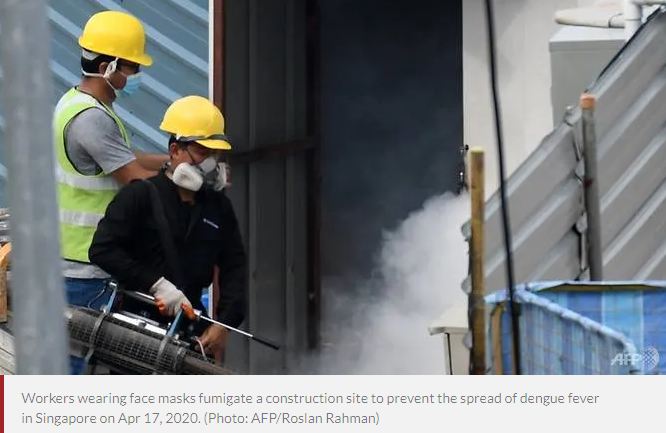
21 stop work orders issued, 10 contractors to be charged over mosquito breeding at construction sites: NEA
this is index.phpSINGAPORE: Twenty-one stop work orders have been issued to construction sites for repeated mosquito breeding offences so far this year, as Singapore experiences a record-breaking dengue outbreak.
Ten contractors will also be charged for repeated mosquito breeding offences, the National Environment Agency (NEA) said in a media release on Wednesday (Sep 16).
A construction site at Serangoon North Avenue 1, located within a dengue cluster, was issued a stop work order on Wednesday. A previous stop work order had been issued to the site on Jul 15.
“Profuse mosquito breeding habitats detected at the site included water ponding in the units of higher floors, with 50 or more larvae at each habitat,” said NEA.
Two stop work orders were also issued to a construction site located within a dengue cluster at Arnasalam Chetty Road and Kim Yam Road on Jul 20 and Sep 9.
Breeding habitats at this site included an air-conditioner compressor, canvas sheet, planter box and wooden frame, said the agency.
Additionally, about 250 summonses were issued to construction sites from January to August this year.
NEA said that it had increased audits at construction sites since Singapore’s “circuit breaker”, prioritising sites within dengue cluster areas and near residential areas.
“All 1,213 construction sites have been inspected at least once since the start of the circuit breaker period,” said the agency.
It added that fewer construction sites have been found to have mosquito breeding, with August seeing a 55 per cent reduction in larval breeding of the dengue-causing Aedes mosquito compared to July.
However, cases of multiple mosquito breeding habitats and habitats with profuse or repeated breeding continue to be detected at some construction sites.
“These egregious cases of mosquito breeding show that some construction site management are still not carrying out the necessary basic vector control checks, despite the current serious dengue situation, and the extensive communications and outreach on dengue prevention over the past few months,” said NEA.
The agency said it would continue regular inspection of construction sites.
WEEKLY DENGUE CASES DECLINING, BUT REMAIN HIGH
There were 726 dengue cases last week, as new infections fell for the fifth week in a row.
NEA said that Singapore was still in the traditional peak dengue season and that weekly cases could remain high beyond October if mosquito prevention measures were not sustained.
Singapore is in the midst of a record-breaking dengue outbreak. A historic record in weekly new cases was surpassed in June, when 895 people were infected in just five-and-a-half days.
The annual tally of dengue cases also surpassed a 2013 record in early August.
On Wednesday, NEA said that 29,206 dengue cases have been reported so far this year.
The agency added that it has closed about 89 per cent of the 2,404 dengue clusters notified since the start of 2020.
However, it said the total number of dengue clusters remains high, with large clusters at these locations:
- Aljunied Road, Geylang Road and Geylang East Avenue 1 and 2
- Arnasalam Chetty Road and Kim Yam Road
- Bukit Panjang Ring Road
- Arthur Road
NEA said it was working with government agencies and town councils on sustained environmental management efforts to combat these clusters.
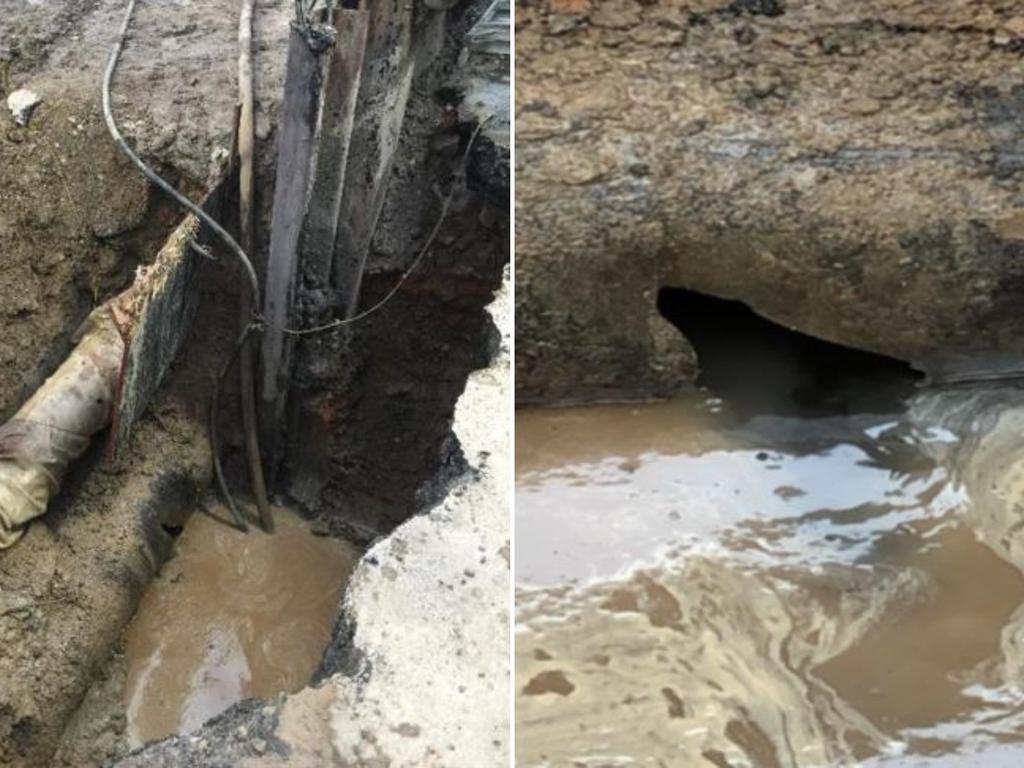
Feng Ming Construction fined for damaging water main, which disrupted supply to nearly 40 homes in Bukit Timah area
this is index.phpSINGAPORE — A construction company has been fined S$56,500 for damaging a large water main and carrying out unauthorised works at Dunearn Road in September 2019, which disrupted water supply to nearly 40 households in the area.
Feng Ming Construction was last month convicted of damaging the 500mm diameter water pipe and fined S$55,000, PUB said in a press release on Monday (Sept 14).
This is the highest fine imposed by the State Courts for water main damage under the Public Utilities Act to date, the agency added.
The company was also convicted and fined S$1,500 for carrying out unauthorised sheet piling installation works.
‘SUBSTANTIAL LOSS’ OF POTABLE WATER
On Sept 20, 2019, Feng Ming Construction was carrying out sheet piling works along Dunearn Road as part of a road-widening project in the Bukit Timah area.
When a piling machine drove a steel sheet pile into the ground, it punctured a water main at a depth of 2.5m under the road surface.
PUB said that it was alerted and immediately went on site to isolate the leak and carry out urgent repair works, which uncovered a hole of about 100mm by 30mm on the water pipe.
“The damage led to substantial loss of approximately 468,000L of potable water, enough to fill about one-fifth of an Olympic-sized swimming pool,” it added.
Water supply to 38 households in the area was disrupted for about nine-and-a-half hours as a result of the incident. A water wagon was deployed and water bags were provided to the affected households.
Investigations showed that Feng Ming Construction was aware of the existence of an underground water main, as indicated in the PUB water service plan.
“However, the contractor had failed to carry out sufficient trial trenching evaluation to physically ascertain the exact location and alignment of the water main,” PUB said.
Under the Public Utilities Act, the penalty for damaging a water main or connecting pipe with a diameter of 300mm or more is a fine of up to S$200,000 or a jail term of up to three years, or both.
This was the second time that Feng Ming Construction had been convicted of damaging a large water main.
The company was also convicted and fined S$40,000 for damaging a 300mm diameter water main along Geylang Lorong 1 in October 2013.
In relation to the works at Dunearn Road in 2019, the firm had also started sheet piling works without submitting a plan for PUB’s approval as required.
Under the Public Utilities (Protection of Water Pipes Infrastructure) Regulations 2017, contractors installing sheet piles or any other similar installations must ensure that the activity is carried out in accordance to an approved plan.
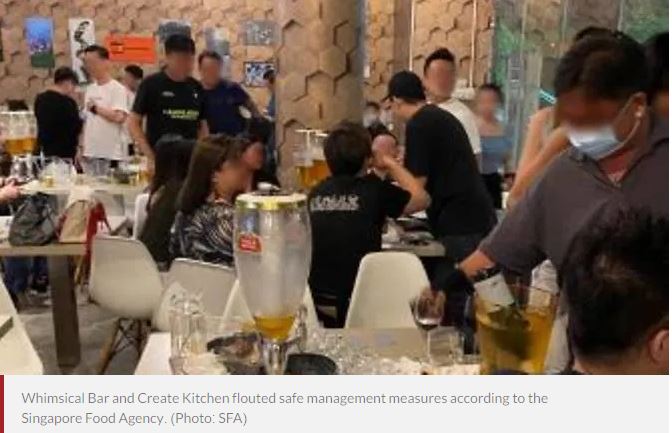
Bar and 2 restaurants fined, ordered to close for breaching COVID-19 safety measures
this is index.phpSINGAPORE: Three F&B businesses at Science Park Drive and Havelock Road were issued an order to close their premises and fined after failing to comply with measures aimed at curbing the spread of COVID-19, said the Singapore Food Agency (SFA) on Monday (Aug 31).
The F&B outlets are: Whimsical Bar at 2 Science Park Drive, an adjacent restaurant called Create Kitchen, and S-Tripes Hotpot located at 731 Havelock Road.
Both Whimsical Bar and Create Kitchen were fined S$1,000, and S-Tripes Hotpot was fined S$2,000.
F&B establishments were allowed to resume dine-in services from Jun 19 under Phase 2 of Singapore’s reopening, but sale and consumption of alcohol at these establishments are prohibited after 10.30pm.
Each group of customers must also be limited to five or fewer people, with at least 1m spacing and no intermingling between groups.
SFA officers found that Whimsical Bar did not implement safe distancing measures between tables and alcohol was served after 10.30pm.
“Tables were spaced less than 1m apart and groups of more than five people were allowed to sit together and mingle,” SFA said.
The agency added that Whimsical Bar was operating a food establishment “without a valid food shop licence” and was ordered to close immediately until it obtains a licence.
The unit adjacent to the bar, Create Kitchen, “violated similar safe management measures”, SFA said, noting that this establishment has a licence to operate as a restaurant. Create Kitchen was ordered to close from Sep 2 to Sep 11.
SFA officers also found that S-Tripes Hotpot restaurant had flouted safe management measures on multiple occasions and it served alcoholic drinks after 10.30pm.
“Staff were not wearing masks or not wearing them properly in spite of reminders.
“Sale and consumption of alcoholic beverages was observed after 10.30pm, with the beverages transferred into teapots and empty green tea bottles before being served to avoid detection,” SFA said.
S-Tripes Hotpot restaurant was ordered to close from Sep 2 to Sep 11.
Under the COVID-19 regulations, first-time offenders will face a fine of up to S$10,000, up to six months jail, or both, SFA said.
Subsequent offenders may face a fine of up to S$20,000, a jail term of up to twelve months, or both.
SFA added that under the Environmental Public Health Act, no person shall operate a food establishment without a valid licence.
“Offenders shall be liable on conviction to a fine not exceeding S$2,000 and, in the case of a continuing offence, to a further fine not exceeding S$100 for every day or part thereof during which the offence continues after conviction,” the agency said.
Last week, 10 F&B outlets were fined for breaching safe distancing requirements.
These breaches include accepting reservations for more than five people, inter-mingling of large groups across tables, failure to observe the minimum 1m distance between tables and allowing alcohol consumption on premises after 10.30pm.

Happy 55th Birthday Singapore!
this is index.phpAnd wishing everyone a happy long weekend. Stay safe and healthy!
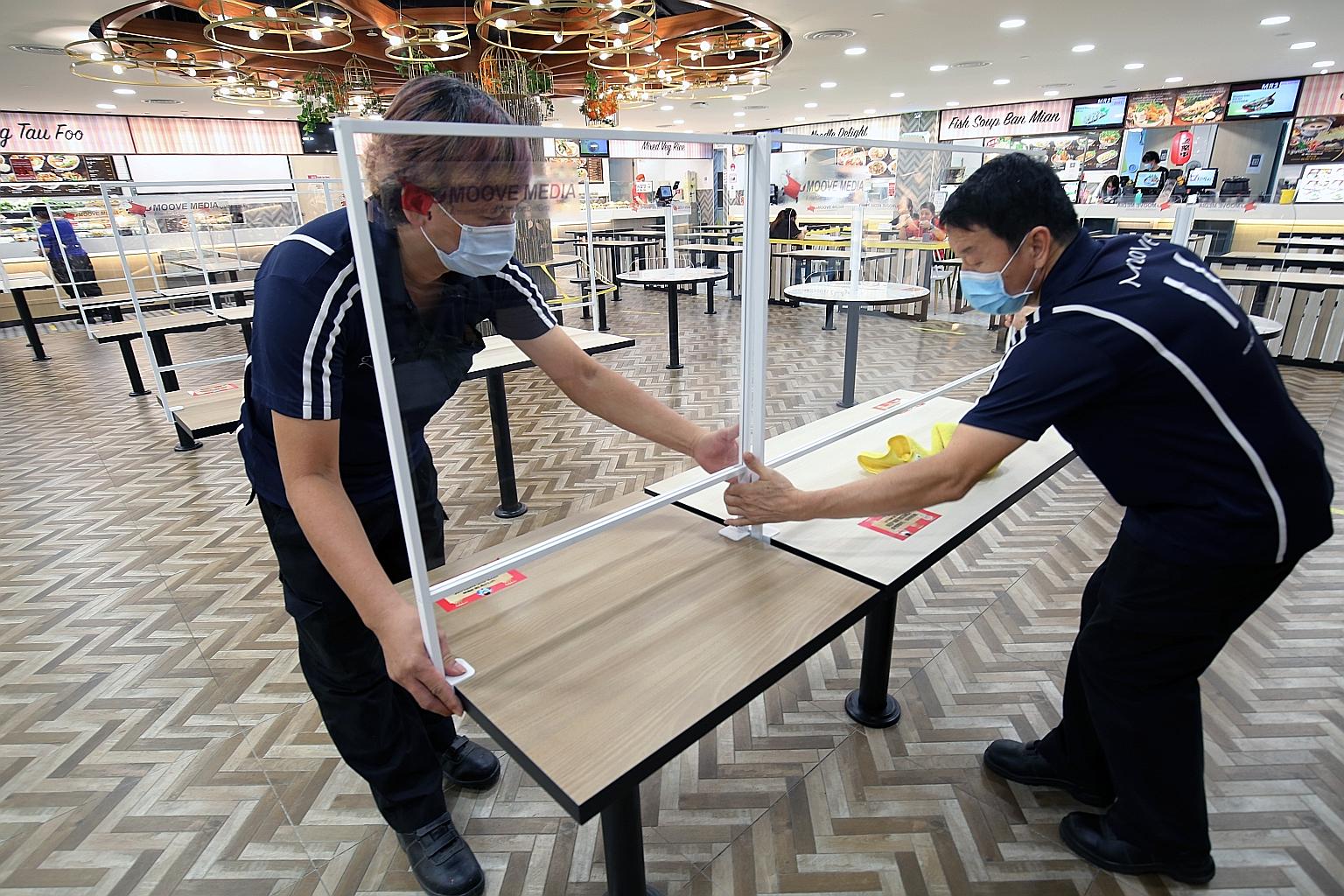
Coronavirus: Table shields could be used when dining at eateries is allowed
this is index.phpAcrylic table shields might be a regular sight at food and beverage (F&B) establishments when dining in is allowed again during phase two of the post-circuit breaker reopening.
At Thomson Plaza’s Koufu foodcourt, 3mm-thick clear acrylic sheets will be installed at 50 tables to separate diners seated across from or next to one another.
Moove Media, the advertising arm of taxi giant ComfortDelGro Corp, said yesterday that it is sponsoring a month-long trial of these acrylic shields, which are similar to the plastic V-Shields currently trialled in 400 ComfortDelGro taxis.
The acrylic partitions are affixed to aluminium holders a distance above the table surface, so that cleaners can wipe the tables without having to remove the shields each time.
TungLok Group, which has 15 brands including Dancing Crab and TungLok Signatures, is also looking at similar prototypes for its restaurants.
Mr Andrew Tjioe, chief executive of TungLok Group, said: “The screens will be an added protection on top of other safety precautions. It’s something that will help customers feel more at ease while dining in.”
The company is currently looking at acrylic partitions with a timber frame, standing about 1.8m tall.
Mr Keith Chua, vice-president of the Restaurant Association of Singapore, noted that clear dividers have been used by eateries in other countries as a way of separating diners and tables.
“If such an approach proves to be an adequate safe measure, it could allow for more seating while preserving a safe environment,” he told The Straits Times.
While the guidelines for dining in have yet to be worked out, operators will have to factor in extra costs to ensure hygiene and safety standards are met, he said.
Delivery and takeaway will likely remain a key revenue source, as safe distancing measures will necessitate reduced capacity, said Mr Chua. One way that eateries can compensate for this is to extend lunch and dinner services to accommodate more turnover of tables, he added.
Ms Nagajyothi Mahendran, director of Samy’s Curry, said she is looking forward to welcoming diners to the Dempsey Road restaurant soon.
However, she has concerns about how strict the rules for dining in will be, and how viable operations will be under the rules.
Safe distancing measures before the circuit breaker, when restaurants were required to leave alternate seats empty, had already reduced capacity by about half, said Ms Nagajyothi.
It is unclear whether this will be further reduced, and how new rules regarding mask wearing will be enforced, she said.
ST understands that the current guidelines by government agencies will be updated soon.
Ms Nagajyothi said: “When people dine in, they tend to hang around and chit-chat. So we’re wondering if there will be guidelines on that, whether they have to wear a mask while waiting for food to be served and whether there will be restrictions on how long guests can spend at the restaurant.”
She added that she hopes restaurants can be given at least a week’s notice to be able to stock up on supplies and prepare for reopening, unlike the four days they were given to shut.
Mr Raymond Khoo, owner and executive chef of The Peranakan, said that he is unsure if he will open his Claymore Connect restaurant during phase two.
“We will need to have staff on two shifts again for lunch and dinner, which might not be cost effective if seating capacity is limited. Our staff are also cautious about what the infection rate will be like, so we are not sure if we want to risk exposure by resuming dining in even if it is allowed in phase two.”
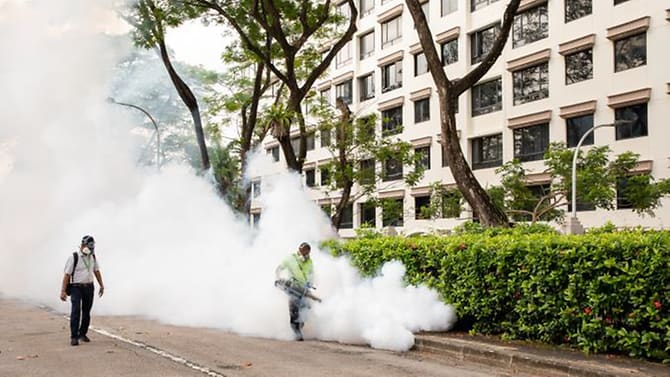
Dengue cases this year could surpass 2013 peak unless urgent action taken: NEA
this is index.phpSINGAPORE: The number of dengue cases this year could surpass 2013’s figure of 22,170, unless urgent community action is taken, the National Environment Agency (NEA) warned on Wednesday (Jun 3).
As of Tuesday, there have been 9,261 reported dengue cases this year, the highest in the same period since 2013, which saw the largest outbreak in Singapore’s recent history, said the agency.
As it stands, the number of weekly dengue cases is expected to exceed the historical high of 891.
There were 735 dengue cases last week, up from the 300 to 400 weekly cases from January to April.
“Singapore has not seen such a high weekly number of dengue cases since the peak years in 2013 and 2014,” said NEA.
“The number of dengue cases this year is expected to exceed the 15,998 cases reported in 2019, and may even surpass the 22,170 cases reported in 2013.”
Twelve people, between the ages of 56 and 80, have died as a result of dengue so far this year. Ten of the 12 had worked or lived in active dengue cluster areas.
“Urgent collective community effort is needed to drastically reduce mosquito breeding habitats and slow down the rise in the number of dengue cases,” said NEA.
COVID-19 A FACTOR BEHIND INCREASE
The agency said the spike in dengue cases can be attributed to several factors, one of which is the increase in Dengue virus serotype 3 (DENV-3) since the beginning of this year.
DENV-3 is a less common strain of dengue that was last seen in a dominant position in Singapore about 30 years ago, meaning there is low immunity in the population and rapid disease transmission.
Singapore is also entering the traditional dengue peak season, when warmer weather facilitates the faster multiplication of the Aedes mosquito and the dengue virus, increasing the chances of dengue transmission. NEA said it has detected more areas with high Aedes mosquito populations.
The COVID-19 outbreak in Singapore and the resulting “circuit breaker” has also exacerbated the dengue situation, said NEA, with the dengue spike in early May coinciding with the circuit breaker measures.
The Aedes mosquito, the main vector of dengue, mainly dwells in indoor spaces and usually bites during the day.
“With a shift in human concentration from offices to homes, more people staying at home during the day also means more blood meals for the female Aedes aegypti mosquitoes, especially in residential areas where the mosquito population is also high,” said NEA.
“Together with the availability of breeding habitats for the mosquitoes, this produced even more mosquitoes. This has likely exacerbated the situation, leading to the sharp rise in the number of dengue infections in the past four weeks.”
From January to May, NEA conducted about 341,000 inspections for mosquito breeding across Singapore and uncovered about 7,800 breeding habitats.
NEA said it has observed a five-fold increase of Aedes mosquito larva detected in homes and common corridors in residential areas during the two-month circuit breaker period compared to the two months prior.
The agency urged homeowners to cooperate with NEA officers in allowing them home access to facilitate checks and indoor misting.
“As we continue to manage the COVID-19 situation, we need to be mindful that dengue is another serious public health threat that Singapore faces,” said NEA director-general of public health Chew Ming Fai.
“During our inspections, we continue to find mosquito breeding in common habitats, such as flower pot plates and domestic containers. Lack of care or diligence in maintaining one’s premises or home could easily lead to mosquito breeding, putting the whole community at risk.”
CONSTRUCTION SITES INSPECTED
NEA has continued to step up preventive surveillance of construction sites, which have been closed during the circuit breaker period.
Before the start of the circuit breaker, construction site operators were instructed to maintain a minimum workforce to perform housekeeping and facilitate pest control services within the sites.
Despite this, NEA observed a two-fold increase in Aedes mosquito larvae at construction sites during the circuit breaker period. So far, 82 per cent of construction sites have been inspected since the start of the circuit breaker, it said.
From January to May, 52 summonses and two stop work orders were issued to construction sites.
Two contractors will also be charged in court for repeat offences, the agency added.
“NEA will continue with our inspection and enforcement efforts, and we will not hesitate to take action against anyone found to have created conditions favourable for the propagation or harbouring of vectors,” said Mr Chew.
“All of us must do our part in our collective fight against dengue.”
Information on the dengue situation can be found on the NEA website, the Stop Dengue Now Facebook page and the myENV app.